Pelatihan Pengelolaan Sampah Rumah Tangga Sebagai Nilai Ekonomi
DOI:
https://doi.org/10.55837/di.v2i2.79Keywords:
household waste, economic value, Kayu Putih, ecoenzymAbstract
The high volume of waste generated by the community is a common problem in the city of Jakarta. The dense population and the high purchasing power of the community plus the limited landfills (TPA) are the causes of the increasingly complicated waste problem. Alternative waste management is needed that can reduce the level of waste accumulation in the landfill. Kelurahan Kayu Putih with an area of 437.15 ha has a population of 48,289 people, RW 08 is one of the densely populated areas in this Kelurahan. The problems faced by the RW 08 community include, first, the waste has not been managed properly, there is often a buildup of waste so that it rots and causes unpleasant odors. Second, how to manage household waste into commodities with economic value so that the benefits can be enjoyed by the RW 08 community.
To overcome these conditions, the PKM FEB Trisakti Team held counseling and training. Counseling is given about the meaning of waste, waste sorting, how to manage household waste both organic and inorganic waste, how to turn household waste into commodities of economic value. Training was conducted to make ecoenzym liquid from organic waste. Discussions were held on the sidelines of counseling and training. The results of the activity showed that knowledge of sorting and managing waste increased from 20 percent to 80 percent, organic and inorganic waste management techniques increased from 10 percent to 100 percent and knowledge of household waste into economic value increased from 10 percent to 100 percent. The results of the implementation of this PKM have met the target because the participants have experienced an increase in insight and understanding above 70 percent of the material provided. Further activities are recommended for inorganic waste utilization training.
References
Aminah, N. Z. N., & Muliawati, A. (2021). Pengelolaan Sampah dalam Konteks Pembangunan Berkelanjutan (Waste Management in the Context of Waste Management). Himpunan Mahasiswa Geografi Pembangunan. Universitas Gadjah Mada.
Astra, I. K. B., Wijaya, M. A., Artanayasa, I. W., & Kardiawan, I. K. H. (2021). Pengolahan Sampah Organik Berbasis Eco Enzyme Sebagai Upaya Pembentukan Karakter Peduli Lingkungan Pemuda Di Kabupaten Buleleng. Proceeding Senadimas Undiksha 2021, 1(1), 2065–2073. https://lppm.undiksha.ac.id/senadimas2021/prosiding/file/279.pdf
Gatta, R., Anggraini, N., Jumadil, Asy’ari, M., Mallagennie, M., Moelier, D. D., Hadijah, & Fauziah Yahya, A. (2022). Transformasi Peran dan Kapasitas Perempuan Rumah Tangga dalam Pengelolaan Sampah Rumah Tangga di Kota Makassar. Jurnal Penyuluhan, 18(02), 265–276. https://doi.org/10.25015/18202237888
Lavany, M. Q. A. (2022). Pengaruh PDRB Per Kapita, Kepadatan Penduduk, Tingkat Pendidikan dan Belanja Lingkungan Hidup Terhadap Timbulan Sampah di Pulau Jawa Tahun 2010-2019. Journal Of Development Economic And Social Studies, 1(4), 563–578. https://jdess.ub.ac.id/index.php/jdess/article/view/85
Peraturan Gubernur. (2020). Peraturan Gubernur 77 tahun 2020 tentang Pengelolaan Sampah Lingkup RW.
Septiawan, I. (2018). Strategi Peningkatan Pengelolaan Persampahan di Kecamatan Ngaliyan Kota Semarang. Economics Development Analysis Journal, 7(2), 111–119. https://doi.org/10.15294/edaj.v8i2.23409
Sudirman, F. A., & Phradiansah, P. (2019). Tinjauan implementasi pembangunan berkelanjutan: pengelolaan sampah kota kendari. Jurnal Sosial Politik, 5(2), 291–305.
Sumiyarti, M., Nuraini, O. N., Noviana, L. F., & Ganani, A. R. (2022). Penyuluhan Nilai Ekonomi Sampah Rumah Tangga Bagi Masyarakat Kelurahan Duri Selatan. ADI Pengabdian Kepada Masyarakat, 2(2), 31–38.
Tampuyak, S., Anwar, C., & Sangadji, M. N. (2016). Analisis proyeksi pertumbuhan penduduk dan kebutuhan fasilitas persampahan di Kota Palu 2015-2025. E Jurnal Katalogis, 4(4), 94–104.
Undang-undang RI No. 18. (2008). UNDANG-UNDANG REPUBLIK INDONESIA NOMOR 18 TAHUN 2008 TENTANG PENGELOLAAN SAMPAH DENGAN. Ph.D. Thesis, Central-South University of Technology, China, 76(3), 61–64.
Windraswara, R., & Prihastuti, D. A. B. (2017). Analisis Potensi Reduksi Sampah Rumah Tangga Untuk Peningkatan Kualitas Kesehatan Lingkungan. Unnes Journal of Public Health, 6(2), 123. https://doi.org/10.15294/ujph.v6i2.15360

Downloads
Published
How to Cite
Issue
Section
License
Copyright (c) 2024 Harmaini, Sumiyarti Sumiyarti , Nazmel Nazir, Cornelia Cornelia, Bi Fadli Ihsan

This work is licensed under a Creative Commons Attribution-NonCommercial-ShareAlike 4.0 International License.
Most read articles by the same author(s)
- Harmaini, Wahyuningsih, Retno Sari Murtiningsih, Ardan Wahyu Prayogi, A Pengembangan Potensi Diri Menghadapi Dinamika Lingkungan Bisnis , Dirkantara Indonesia: Vol. 2 No. 1: Maret-Agustus 2023
- Agustina Suparyati, Sumiyarti Sumiyarti, Rahmadianti Thomas, Sosialisasi Konsep Bankable dalam Pengelolaan Bank Sampah: Studi Pengabdian Masyarakat di Desa Mangunjaya, Kabupaten Bekasi , Dirkantara Indonesia: Vol. 4 No. 1 (2025): Maret-Agustus 2025
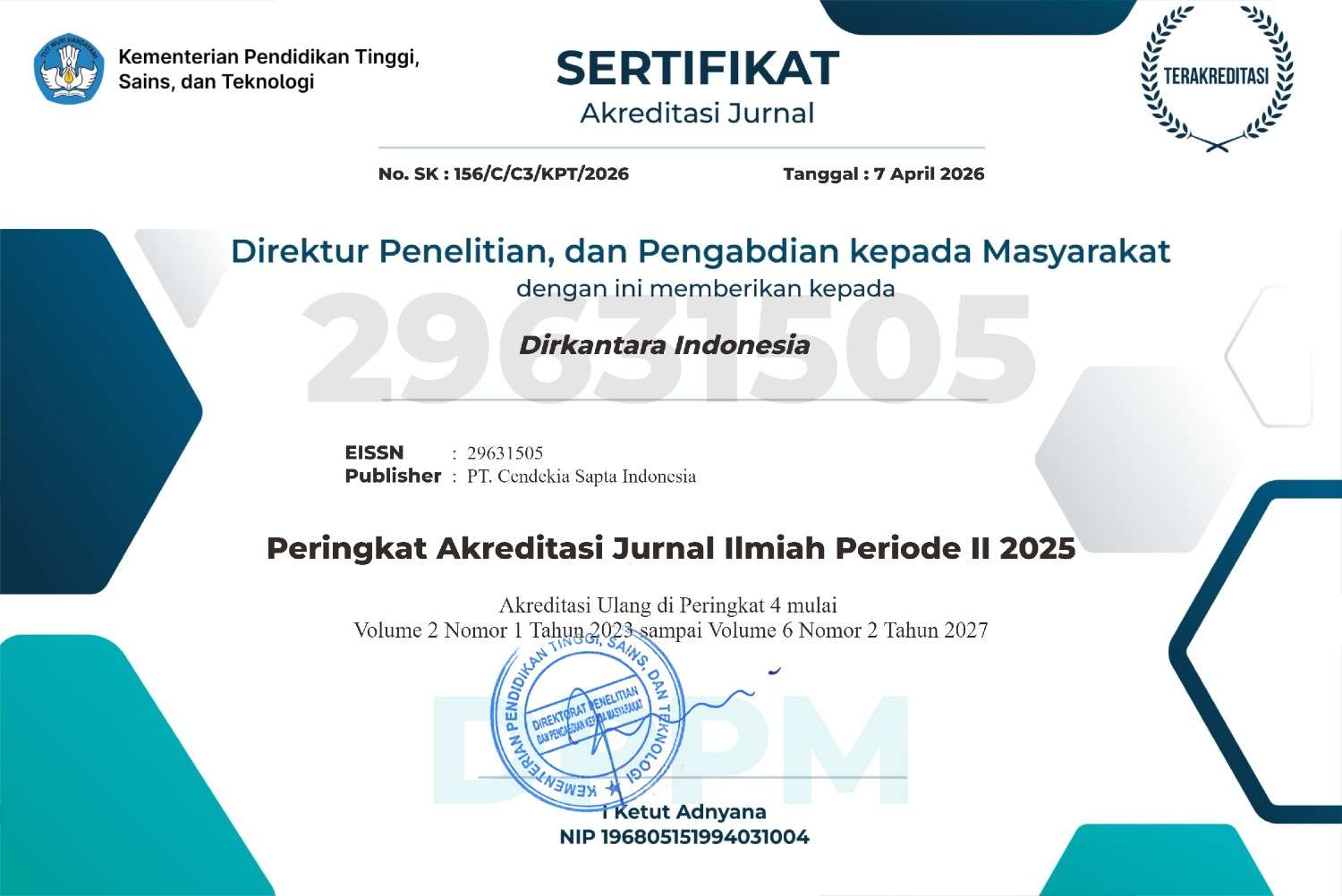
Sertifikat Sinta 4
No. SK: 156/C/C3/KPT/2026
Template

Indexing