Pengenalan Penggunaan Media Sosial Sebagai Sarana Untuk Memasarkan Produk Kepada Mitra UMKM
DOI:
https://doi.org/10.55837/di.v2i2.67Keywords:
digital marketing, social media, marketing strategyAbstract
The impact of the pandemic has been felt in all aspects of life, especially the economy in Indonesia. There are many business sectors that have been forced out of business because they are unable to deal with the brunt of this deadly virus. As time goes by, conditions that are getting better after the pandemic require entrepreneurs to start opening their businesses again. The existence of positive opportunities makes MSME actors have enormous potential to be successful in the market, if they can adopt the right marketing strategy. The SME group in the Depok area, to be precise, the Azalea Grand Depok City Sector, have started learning to build small businesses in local residential areas. Before this activity was carried out, several participants were recorded as not having Social Media accounts, not even using Social Media for their product marketing activities. After this activity was held, it was discovered that 90% of the Counseling and Training participants had Social Media Accounts, 90% had Instagram/Tiktok accounts, 80% used their accounts to promote their products, and 95% stated that the counseling and training was useful for them.
References
Abzari, M., Ghassemi, R.A. and Vosta, L.N. (2014), “Analyzing the effect of social media on brand attitude and purchase intention: the case of Iran Khodro Company”, Procedia-Social and Behavioral Sciences, Vol. 143 No. 14, pp. 822-826.
Bae, Y. and Lee, H. (2012), “Sentiment analysis of twitter audiences: measuring the positive or negative influence of popular twitterers”, Journal of the American Society for Information Science and Technology, Vol. 63 No. 12, pp. 2521-2535
Brown, M. (2014), “Constructing social media”, Construction Innovation, Vol. 14 No. 3.
Cha, M., Haddadi, H., Benevenuto, F. and Gummadi, K.P. (2010), “Measuring user influence in twitter: the million follower fallacy”, Proceedings of the Fourth International AAAI Conference on Weblogs and Social Media, pp. 10-17
Erkan, I. and Evans, C. (2016), “The influence of eWOM in social media on consumers’ purchase intentions: an extended approach to information adoption”, Computers in Human Behavior, Vol. 61 No. 3, pp. 47-55.
Lee, D., Hosanagar, K. and Nair, H.S. (2018), “Advertising content and consumer engagement on social media: evidence from Facebook”, Management Science, Vol. 64 No. 11, pp. 5105-5131.
Philip T. KotPalmer, S. (2017), “Characterization of social media interactions for a national information and communication technology professional association”, International Conference on Information Technology and Applications, ICTIA, Sydney, pp. 1-7
Tariq, A., Wang, C., Tanveer, Y., Akram, U. and Akram, Z. (2019), “Organic food consumerism through social commerce in China”, Asia Pacific Journal of Marketing and Logistics, Vol. 31 No. 1, pp. 202-222.
Turban et al., , Electronic Commerce (2018), “A Managerial Perspective”, Pearson
Zhang, L., Li, D., Cao, C. and Huang, S. (2018), “The influence of green washing perception on green purchasing intentions: the mediating role of green word-of-mouth and moderating role of green concern”, Journal of Cleaner Production, Vol. 187 No. 2, pp. 740-750.
Zhao, L., Lee, S.H. and Copeland, L.R. (2019), “Social media and Chinese consumers’ environmentally sustainable apparel purchase intentions”, Asia Pacific Journal of Marketing and Logistics, Vol. 31 No. 4, pp. 855-874.

Downloads
Published
How to Cite
Issue
Section
License
Copyright (c) 2024 Rayi Retno Dwi Asih, Aekram, Hermi

This work is licensed under a Creative Commons Attribution-NonCommercial-ShareAlike 4.0 International License.
Similar Articles
- Henny Setyo Lestari, Wiwik Robiatul Adawiyah, Nirdukita Ratnawati, Muhammad Evirel Frasya, Maharani Dheva Dwi Safitri, Pelatihan Digital Marketing: Membuat Konten TikTok Untuk Pemasaran , Dirkantara Indonesia: Vol. 4 No. 1 (2025): Maret-Agustus 2025
- Hermanto Yaputra, Robert Kristaung, Rinaldi Rustam, Peran Digital Marketing Bagi Perkembangan UMKM Rufata Di Jakarta , Dirkantara Indonesia: Vol. 4 No. 1 (2025): Maret-Agustus 2025
You may also start an advanced similarity search for this article.
Most read articles by the same author(s)
- Rayi Retno Dwi Asih, Robert Kristaung, Perancangan Komunikasi Pemasaran Digital melalui Media Sosial di Era Industri 4.0 di Sekolah Cordova , Dirkantara Indonesia: Vol. 1 No. 1: Maret-Agustus 2022
- Mona Adriana, Rayi Retno Dwi Asih, Astrid Maria Esther , Putri Oktriana , Fitri Ningsih , Digitalisasi Menjadi Sebuah Strategi Baru Sektor UMKM , Dirkantara Indonesia: Vol. 1 No. 2: September-Februari 2023
- Regina Jansen Arsjah, Rayi Retno Dwi Asih, Lenggogeni, Pengembangan Analisis Laporan Keuangan untuk Meningkatkan Literasi Keuangan dan Efisiensi Operasional UMKM , Dirkantara Indonesia: Vol. 4 No. 1 (2025): Maret-Agustus 2025
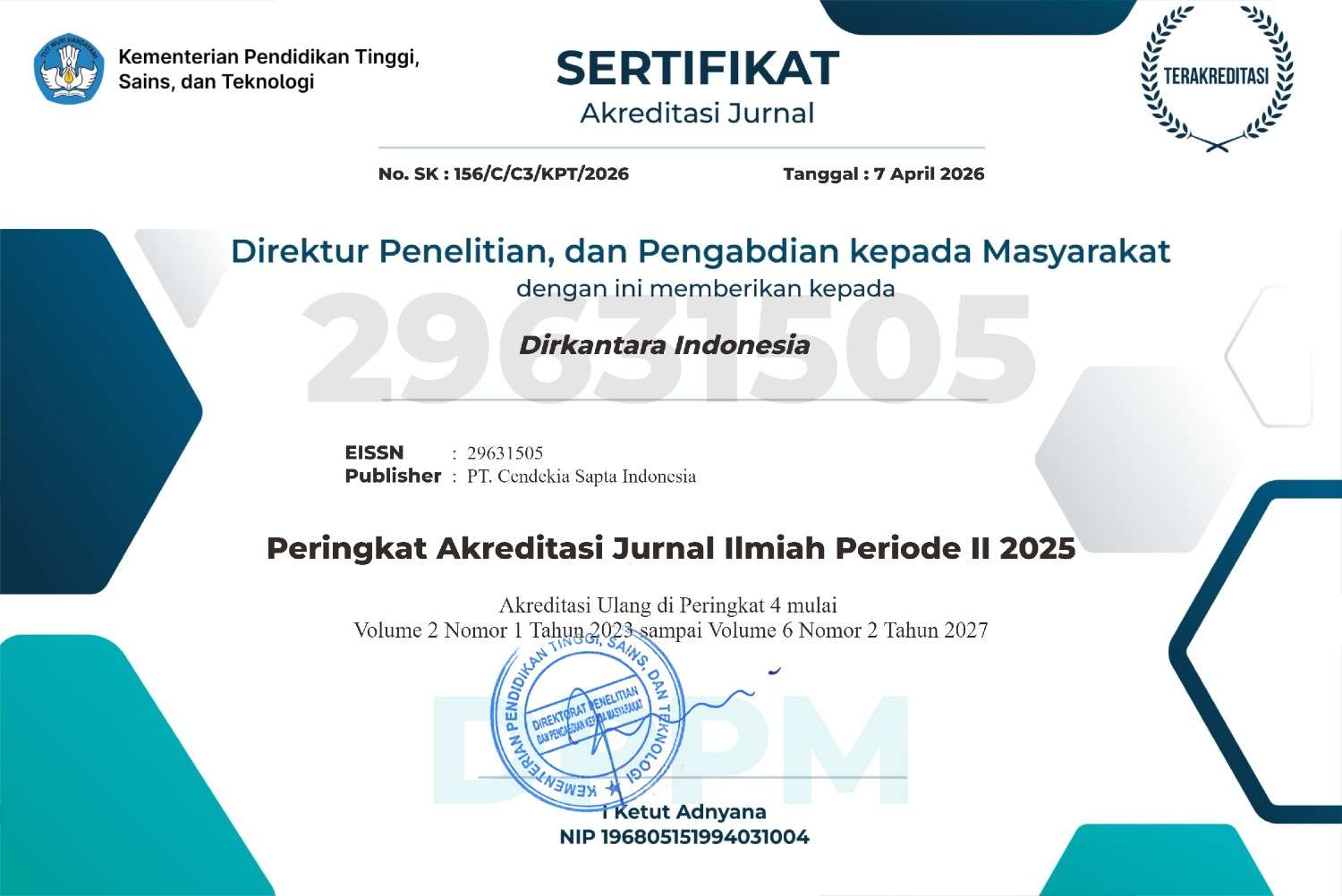
Sertifikat Sinta 4
No. SK: 156/C/C3/KPT/2026
Template

Indexing