Pelatihan Dasar-Dasar Public Speaking yang Efektif bagi Komunitas Bank Sampah di Tambun Selatan
DOI:
https://doi.org/10.55837/di.v4i1.171Keywords:
Waste Bank Forum, Public Speaking, Training, EffectiveAbstract
Public speaking is a fundamental skill essential for individuals, especially those who frequently interact with the public. The Waste Bank Community in Tambun Selatan, Bekasi, as the partner of this program, still faces challenges in delivering messages clearly, confidently, and persuasively during socialization and community presentations. To address these needs, the Faculty of Economics and Business, Trisakti University, organized a Community Service program focusing on training the basics of effective public speaking for Waste Bank members.
The training methods included counseling, interactive discussions, presentation simulations, and role-play exercises based on real cases encountered by the community. Thirty members participated in the program, selected through recommendations from the Waste Bank administrators. Evaluation was conducted through pre-test and post-test to measure improvements in speaking techniques, audience engagement, body language, and self-confidence.
The results showed significant improvement in participants’ public speaking skills, with average scores increasing from 50% in the pre-test to 83% in the post-test. Participants also demonstrated greater confidence in speaking publicly, better structured presentations, and improved vocal and body language techniques.
This program proves that practice-based training effectively enhances community members’ public speaking skills. Future training initiatives are expected to be sustained to further strengthen communication capacity in conveying environmental messages to the broader community.
References
Chambers, H. E. (2020). Kirkpatrick’s four levels of training evaluation: A practical guide. Routledge. https://doi.org/10.4324/9780429443304
Dwivedi, Y. K., Hughes, D. L., Coombs, C., Constantiou, I., Duan, Y., Edwards, J. S., Gupta, B., Lal, B., Misra, S., Prashant, P., Raman, R., Rana, N. P., Sharma, S. K., & Upadhyay, N. (2021). Impact of COVID-19 pandemic on information management research and practice: Transforming education, work and life. International Journal of Information Management, 55, 102211. https://doi.org/10.1016/j.ijinfomgt.2020.102211
Kaur, G., & Sharma, S. (2022). Public speaking in the digital era: Challenges and opportunities for effective communication. Journal of Communication Studies, 40(2), 145–160. https://doi.org/10.1080/10510974.2022.2090872
Kolb, D. A. (2015). Experiential learning: Experience as the source of learning and development (2nd ed.). Pearson Education.
Lucas, S. E. (2020). The art of public speaking (13th ed.). McGraw-Hill Education.
Mahmood, S., Hussain, T., & Khan, M. A. (2021). The role of communication training in improving students’ presentation skills: An experimental study. Education and Training, 63(5), 701–717. https://doi.org/10.1108/ET-10-2020-0311
Robbins, S. P., & Judge, T. A. (2019). Organizational behavior (18th ed.). Pearson Education Limited.

Downloads
Published
How to Cite
Issue
Section
License
Copyright (c) 2025 Koramen Haulian sirait, Nico Lucito , Lydia Rosintan , Agustina Suparyati

This work is licensed under a Creative Commons Attribution-NonCommercial-ShareAlike 4.0 International License.
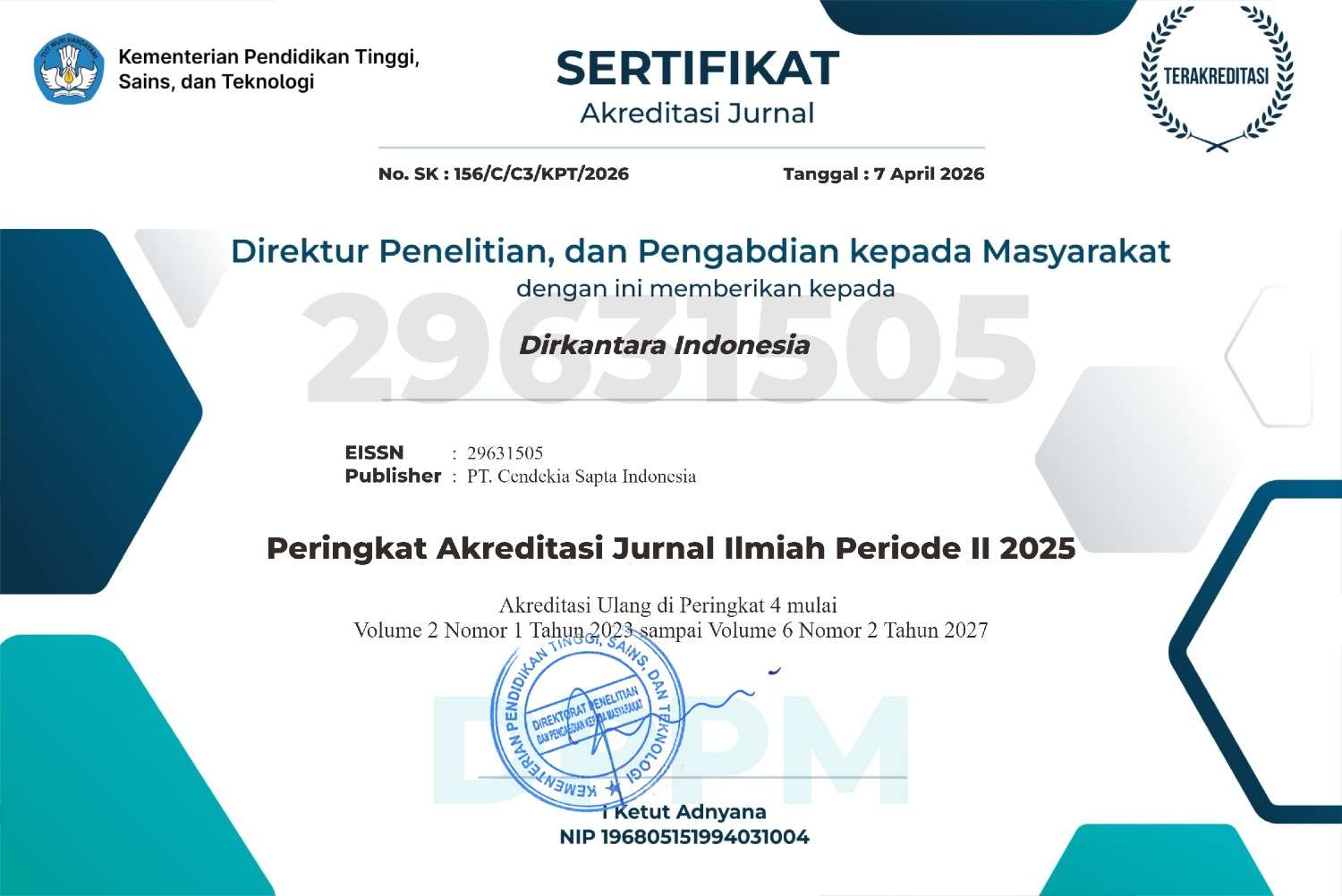
Sertifikat Sinta 4
No. SK: 156/C/C3/KPT/2026
Template

Indexing