Strategi Peningkatan Keterampilan Kemampuan Berkomunikasi Bagi Siswa Sekolah Kewirausahaan Cordova
DOI:
https://doi.org/10.55837/di.v4i1.129Keywords:
komunikasi, Kerjasama Tim, Survey, Existing PelangganAbstract
S In the post-pandemic era, small and medium enterprises (SMEs) are required to strengthen communication skills to manage their businesses effectively. The Cordova School of Entrepreneurship, as a partner in developing young entrepreneurs, faces challenges in communication skills, both within teams and with customers. This community service program (PkM) aimed to enhance the communication skills of Cordova students through training in effective communication techniques. The implementation method included workshops, presentations, discussions, and case consultations. A total of 22 participants attended the program on December 17, 2023. The evaluation results indicate improved understanding of communication planning, channel selection, public speaking, and the linkage between communication strategies and target market determination. Participants demonstrated high enthusiasm during the discussions and expressed interest in further mentoring to apply communication strategies. This program provides tangible benefits in strengthening the communication capacity of SMEs, which is expected to improve their business competitiveness in the post-pandemic era. In the future, the program has the potential to be expanded through continuous mentoring and integration with SME digitalization initiatives.
References
Chambers, R. (1994). Participatory rural appraisal (PRA): Analysis of experience. World Development, 22(9), 1253–1268. https://doi.org/10.1016/0305-750X(94)90003-5
Dwivedi, Y. K., Ismagilova, E., Hughes, D. L., Carlson, J., Filieri, R., Jacobson, J., Jain, V., Karjaluoto, H., Kefi, H., Krishen, A. S., Kumar, V., Rahman, M. M., Raman, R., Rauschnabel, P. A., Rowley, J., Salo, J., Tran, G. A., & Wang, Y. (2021). Setting the future of digital and social media marketing research: Perspectives and research propositions. International Journal of Information Management, 59, 102168. https://doi.org/10.1016/j.ijinfomgt.2020.102168
Hmelo-Silver, C. E. (2004). Problem-based learning: What and how do students learn? Educational Psychology Review, 16(3), 235–266. https://doi.org/10.1023/B:EDPR.0000034022.16470.f3
Kaur, G., & Sharma, S. (2022). Enhancing entrepreneurial success through communication competence: A study of young entrepreneurs. Journal of Entrepreneurship in Emerging Economies, 14(5), 1013–1031. https://doi.org/10.1108/JEEE-04-2021-0167
Kirkpatrick, D. L. (1996). Evaluating training programs: The four levels. Berrett-Koehler.
Kolb, D. A. (1984). Experiential learning: Experience as the source of learning and development. Prentice-Hall.
Kristaung, R. (2023). Digital transformation and communication strategy for SME resilience in Indonesia. Journal of Entrepreneurship and Business, 11(2), 145–160. https://doi.org/10.54099/jeb.v11i2.567
Mondy, R. W., & Martocchio, J. J. (2016). Human resource management (14th ed.). Pearson.
Offerdal, T. S. (2024). A limit to how much you can plan – Planned and improvised strategic communication during COVID-19. Corporate Communication: An International Journal, 29(1), 45–62. https://doi.org/10.1108/CCIJ-02-2023-0016
Robbins, S. P., & Judge, T. A. (2019). Organizational behavior (18th ed.). Pearson.

Downloads
Published
How to Cite
Issue
Section
License
Copyright (c) 2025 ANDREAS WAHYU GUNAWAN PUTRA, Nico Lukito

This work is licensed under a Creative Commons Attribution-NonCommercial-ShareAlike 4.0 International License.
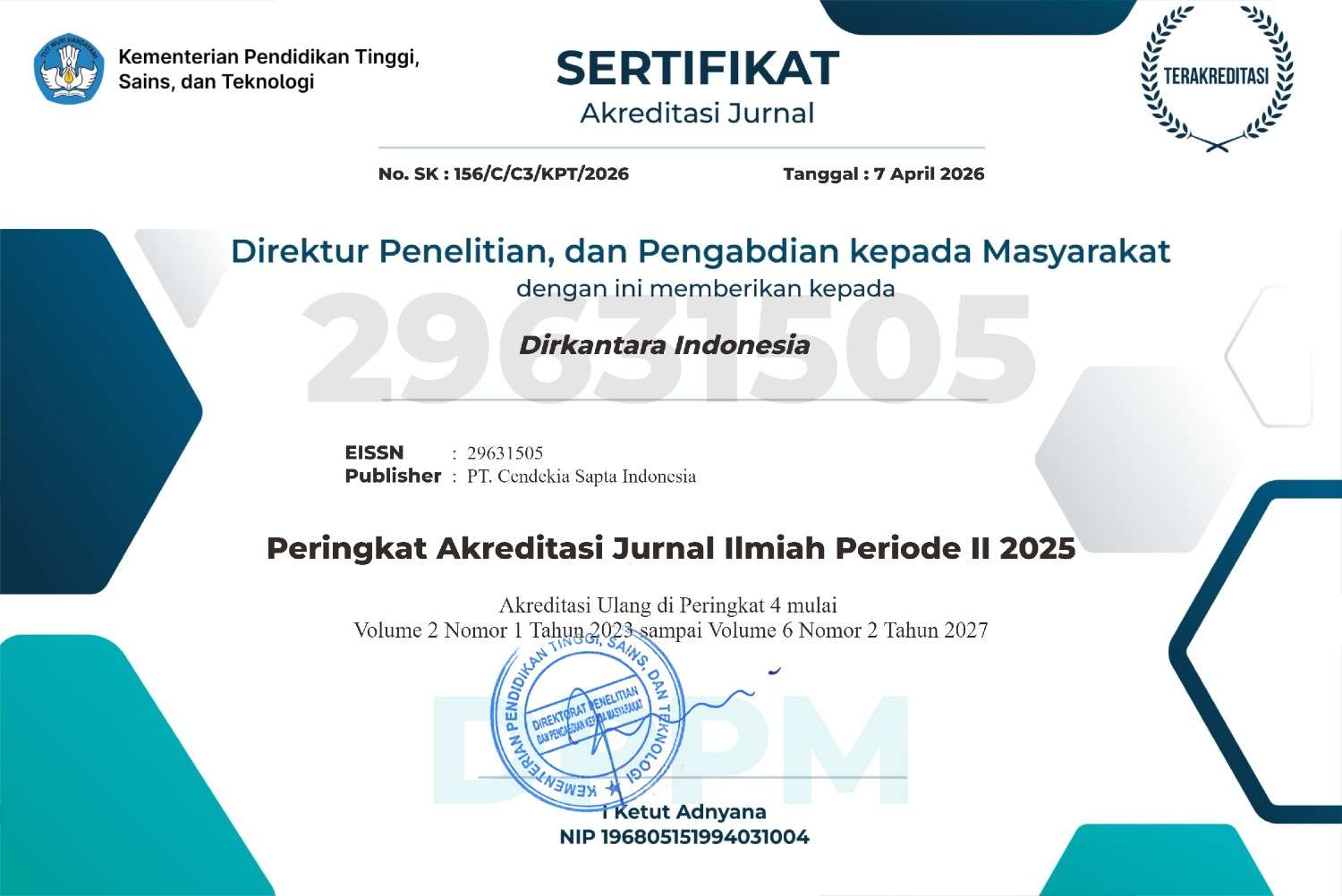
Sertifikat Sinta 4
No. SK: 156/C/C3/KPT/2026
Template

Indexing